OUR ADVERTISERS

Showing posts with label "how to". Show all posts

Wednesday, August 10, 2011

How to remove old rusted crank arms

Every once and a while you'll come across this mess. A rusted crank arm that needs to be removed on a bike that's been sitting out in the elements for years. The odds of an easy job are 50/50 but with a little preparation, that goes up 95/5.

Hope of an easy job is for amateurs. Taking these simple steps will save yourself time, frustration, stress, bloody knuckles and some money out of the swear jar. Another benefit will be a longer life for your tools, read on.

The first step is removing that crappy little plastic cover that hides/protect/prevent access to the 14mm lock nut on the axle. Use a big coin in the slot and unscrew it. This will give you better torque control and the larger surface will distribute the energy more evenly (I'm sure there's a special tool for that but you probably, like me, already have this freely available in your pocket.).

Did it work? It came off no problem? If the answer is yes, buy a lottery ticket. These damn things usually explode in pieces because they get brittle over time. You didn't win the jackpot then? No worries, just jam a very small flat head screwdriver between the plastic and the locknut. Then slowly pry the remains of the cover off.

Second, using a 14mm socket wrench, remove the axle locknut.

Third, prepare! Before going any further you need to do a few things. Get yourself an old toothbrush, again free, and clean the thread inside the crank arm nut housing. Next use a lubricant (NOT WD40) and lube those threads. You would be surprised on how one grain of sand can ruin your day here. As far as lube goes, anything but the aforementioned fish oil stuff will do. I use Duralube engine treatment, 1 quart goes a long way on everything and it's like liquid bearings.

We're still not done. Apply oil on all the threads of your puller and on the end of the shaft that will push off on the axle. While using your puller, the friction creates a lot of heat and that's what can damage your investment in the long run. Be cool, lube your tool.

Click on image for full size

Click on image for full size


Now you can go ahead and use the puller and the crank arm should fall right out as it did in this case. Hope you found this useful.

Don't forget to check out the how-to articles post
and download my free bike maintenance book if you haven't already.

Until next time, ride safe and free.

Gerry :)

Monday, March 23, 2009

HOMEBUILT BIKE FRAME EXTENSION


In spite of chaos at work and digging out of home improvement Hell, I've managed to get one of my Spring time projects started. I've been using my Firmstrong Chief bike as my workhorse now for some time and I always wanted a big cargo bike of my own design. Since the Chief is very comfortable and easy to ride, it was a logical step to see what I could do to upgrade it instead of starting from scratch again. I like to be able to carry a lot of stuff and although trailers are great for that, I must admit that they are a pain to haul.

Xtra cycle makes a great product that includes an extension and a rack to make any bike into a serious cargo hauler. I've seen them and they are worth the money no questions. However, I think you folks would enjoy a homebuilt project more than just a simple install/product review article. I'm also a cheap skate and I had all this scrap lying around for free to put this thing together!

Xtra cycle was the inspiration for the want and this great instructable(trebuchet03's article) was the inspiration for the how. Making a bike frame extension requires a few things, the rear triangle from a cheap suspension mountain bike, the down tube from another bike with part of the head tube still on and some brackets.

I simply bolted the rear triangle of the MTB frame where the rear wheel on the Chief is supposed to be using it's pedal axle and the bolts that come with it. I then measured the cut down tube for lenght while the bike was resting on a block at the proper height. I cut the tube, clamped it in a wise for it to fit inside the shock mount on the rear triangle and drilled a hole for the mounting bolt. The other end of the tube was then secured to the seat tube of the cruiser using 3 clamps. Why 3? Remember the golden rule of homebuilt anything, when in doubt, overbuild!

The bike is nowhere near done, I still have to make the custom 34 inch long rear rack that's going on it, but extensive testing of me jumping my big butt on the seat has proven successful with no flex whatsoever.


Keep posted for the rest of this build.

Until next time, ride safe and Godspeed.

Gerry :)

Sunday, September 09, 2007

HOW TO BUILD AN INEXPENSIVE SUSPENSION RECUMBENT BICYCLE AT HOME PART 2 THE FRONT BOOM

Before we build anything, we need some more parts. You need a road bike frame and fork. The fork will be used to connect the front boom to the frame and you will make the front boom from the lower part of the road bike frame. See and enlarge the image. You will also need the top tube of that bike to make the steerer tube extension which will be covered in the next post.

So you had some fun with the hacksaw and you have all your bits, let's start. I removed the bits of the seat tube on the mountain bike frame since they won't be needed. This will save just a little weight as well. Not a lot, but homebuilt recumbents are notorious for being heavy, so every little bit helps.

Now I have a drill press, but since most of you out there don't, I will use a regular drill to make my holes so you can see that it is possible. 15 years ago when I built my first recumbent I had a revelation when I realized that a fork steerer tube would fit almost perfectly inside a seat tube. That's where all those road bike frame parts come into play. Cut the lower frame of the bike as illustrated in the first image, cut more and remove some length later if it's too long. Now set that piece aside after cutting a slit about 4 inches long in the seat tube where it will be inserted in the steerer tube. This will help when installing the clamps in final assembly.

Now take the fork and cut it at the end where it starts to curve. Close to that cut, drill a hole on each side. Make sure that your holes are aligned. Now slide the cut fork in the mtb frame so that the steerer tube faces forward. See where you want to make your holes in the mtb frame and mark them. Drill the holes and bolt the cut fork into place. Voila, you have done the first step in building the front boom. The front boom will hold the pedals, crankarms and front deraillleur.

Noticed that we only installed one nut and bolt, this is to permit you to see where you want the boom assembly to sit. You want to make it as level with the seat as possible and high enough so you don't hit the wheel with your feet when turning and pedaling. At this point, it's educated guesswork since we have no seat, so do the best you can or wait for the end of this story. Building a recumbent yourself involves a lot of guesswork and return visits to the drawing board. Heck, that's half the fun. :) This recumbent will most probably end being the kind that you hit the wheel when you pedal and turn sharply. I don't have a problem with that since I found a solution for me some years ago: don't pedal when you turn.

After finding where you want the boom to sit, mark where your holes will be and drill them. You might end up with a gap between the fork legs and the mtb frame. Fill those gaps with washers and make sure to use the same number and size on both sides. Your boom must be aligned with the rest of the frame. Bolt down tightly and you will check those bolts for tightness after a few miles when it's done, if you have half a brain.

Lastly, insert the road bike seat tube that you cut into the steerer tube and admire your progress. At this point we don't have a seat and we are pretty clueless on where it will finally end up. So for now we will leave it alone.

The next post will cover the handlebars and how to make an extension for them.

Until next time, ride safe and Godspeed.

Gerry :)

Recumbent build Part 1
Recumbent build Part 3
Recumbent build Part 4

Sunday, September 02, 2007

HOW TO BUILD AN INEXPENSIVE SUSPENSION RECUMBENT BICYCLE AT HOME PART 1


WARNING! LONG POST BELOW.

Well it should be, how else can I explain all this. :) I have been building recumbent bikes myself for the last 12 years. I've built 7 or 8 of them, I stopped counting at some point. "Recumbent Bicycle" was the very first search I did when I got connected on the web and that's where that crazy quest started. My main goal was to build a reliable recumbent for not too much cash. It took me 7 (or 8) bikes to accomplish that and I had a blast in the process. Building your own bike provides even more pleasure in the "quest" itself of making your own ride work. Finding solutions for all the bugs and actually making it work is truly rewarding.

I loved building and riding these bikes until I built the last one that was actually a very reliable ride. Then many things came into play for me to lose interest, I had reached my goal, I moved to the city (Montreal streets are notoriously bad) and I started getting into cruisers. Until 2 weeks ago when something happened...

...I hurt my back! No way I could ride my cruiser in this condition. The timing was awful since I was planning to ride at critical mass and I was invited for a night cruise with the Hannan choppers afterward. So out came my pocket rocket recumbent from the mothballs and I rode for at least 8 hours and had a blast that evening. I was surprised that after at least 5 years of leaving that thing alone in storage, all I had to do was adjust the brakes, put some air in the tires and it ran solid the entire ride. Even did some pretty stupid stuff and came out of it with flying colors.

The other ingredient for that mechanical soup, that you are about to learn about, was a donation of a full suspension mountain bike from a friend. I started thinking"hmmm, I always wanted to build one with a rear suspension..." and the mad recumbent builder took over like Mr Hide.

So here we go, let's build a rear suspension recumbent bike from junk. :)

First thing I had to do was strip the old mountain goat to the bare frame. There was nothing left to use on this thing. It was one of those rare bikes that I find with no useful parts left and the damn thing made me sweat 2 hours to take it apart. I had to hacksaw my way to her guts! I will have to make sure that corrosion doesn't become an issue later on, it was bad.

I gathered the parts that I already have: 20 inch wheel and tire, matching fork( I can't keep the original fork because I want to lower the frame and be able to use brakes on the front wheel.), a spare rear shock(nothing fancy just a regular Chinese job) since the original one is dead and my faithful "Pocket Rocket" recumbent to donate the rest of the parts. I will have to make another seat since the suspension doesn't allow me to use the one from that bike, more R&D.

After stripping the mtb I installed the fork and 20 inch wheel to see how it will sit and give me some ideas for problems to come. One big issue in any recumbent build is chain management. This one won't be different. Expect a full post just for that. At this point it is time to decide how you will progress and think of solutions. Good exercise for your brain believe me.

The next ingredient that we will need for this build is a men's road bike frame for various parts, more on this in part 2. Now this post will have all the links to all the articles for this build. I will try to update the build at least once a week. This all depends on how things go and what kind of wall I hit.

Lastly, before you go out all crazy and build one of these, be warned! These bikes go real fast downhill and if you are not careful about how you build one, you can very simply kill yourself. I am not there to take you by the hand to build anything, so don't come crying to me if your are stupid enough to build a bike half assed and get hit by a truck. I have listed other recumbent sites in the sidebar and I have many recumbent sites in the Bicycle Search Engine, do your research. Finally, always respect the number one rule of all homebuilders: When in doubt, OVER BUILD.

Til next time, ride safe and Godspeed.

Gerry :)

Recumbent Build Part 2
Recumbent Build Part 3
Recumbent Build Part 4

Sunday, August 27, 2006

HOW TO BUILD A CHEAP BUT GOOD BICYCLE TRAILER

A little while ago I built a big cargo trailer so I could carry big and heavy loads. Th experience was succesful, but the trailer is a bit too big for everyday use like getting groceries. So I decided to build a smaller one with a built-in carrying box to avoid dirtying my groceries or whatever stuff I wanted to carry. Here you will find a complete how to article on how I did this, except for the hitch. The details for the hitch construction can be found on the big trailer build.
My first idea was to build this from broken hockey sticks. New lumber is always green and it never comes out straight. Hockey sticks are always straight, strong and broken ones can usually be found for free. But no luck in finding hockey sticks at this time of the year, but I did find a baby crib in the trash and that would do just fine. It also came with a board to cover the frame, bonus! I also found a kids bike with 14 inch wheels and tires in the trash and an old abroller to make the trailer arm. Broken dreams of easy perfect sixpack abs would now be transformed into sexy strong leg muscles! I salvaged parts from the bike as well that can be used on full size bikes, a sidepull brake caliper and pads, brake cable and housing, chain, a headset washer for my CCM Galaxie project, a bell, various nuts and bolts.

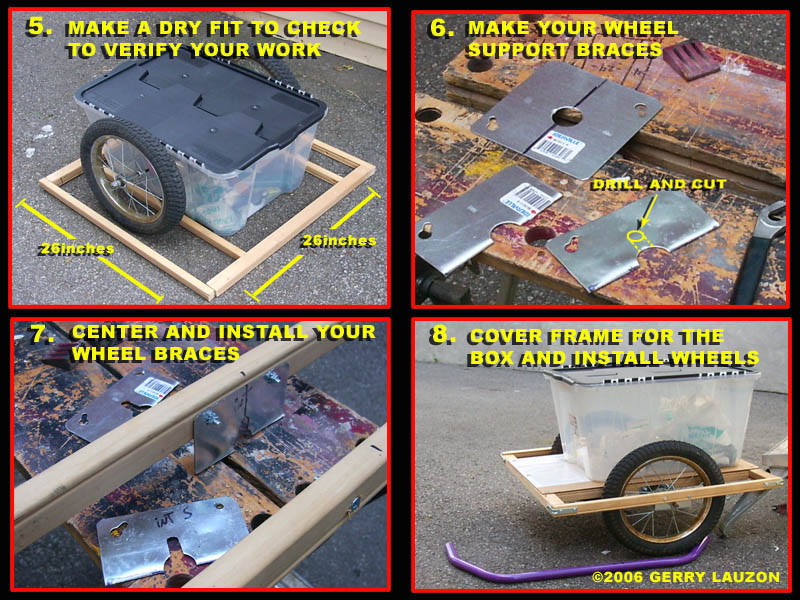
First I dismantled the crib bottom to salvage the lumber and board. I cut everything to size for my use. The trailer measures 26 inches by 26 inches. Since I was using a front and rear wheel, the gap between the outside and inner side was different. Take your measurements from the wheels you'll be using and make the frame accordingly.


Second, I screwed the frame
together using Robertson wood
screws and steel corner braces. I then did a dry fit assembly just to make sure that everything was coming out right.


Third, take some electrical box cover plates to make wheel mounts. Cut them in half. Drill a hole and then with a hacksaw, cut a channel for the axle to go in. I made one a little higher than the other to allow for some camber in the wheels(The wheels tilt inward if you look at the trailer from the front or back). This makes the trailer more stable. Mark your plates "inside" "outside" so you don't mix them up during assembly. Mark the middle of the frame and the middle of the plates. Drill some holes and bolt the plates to the frame. Put on your wheels and make sure that they are both parallel and straight to the frame. Take off the wheels and paint the frame.


Fourth, reinstall the wheels and make your trailer arm. I used an old abroller, but any piece of steel or aluminium tubing properly bent will do. The distance between the trailer and the hitch attachment should be 16 inches, I have a 26 inch wheel bike . I screwed in a piece of wood to the frame to elevate the arm to the proper height and then screwed in the arm in that piece thinking it would be strong enough...WRONG! At the first test ride, I almost lost my trailer into rush hour traffic, I had put in a safety strap just in case and that saved the day. I went back and drilled two holes through the arm, wood spacer and the frame. I used two front wheel axles to bolt everything solidly together. I ignored my first rule of homebuilt vehicles: When in doubt, ALWAYS OVERBUILD!

Fifth, Screw in the carrying box to the frame and use some washers. I bolted the box at 6 places. I also added a small tool box in the front to carry my lock and bungee cords in the same fashion. Leave some space between the tool box and the main carrying box so you'll be able to open its cover. Screw in some hooks around the frame so you can attach bungee cords to lock the lid in place or to strap down extra stuff carried on top of the box. Install a reflector on the back of the box or a light if you plan on using it at night. Pin to your bike and go get stuff.


The first grocery run

I used the trailer on the very first day. I went out to get $60 worth of groceries about 3km away. I used to go and get whatever I could carry in one bag or on my rear rack, which is not much. People where looking at me funny when I came out of the store and headed for the bicycle stands with my grocery cart! I had bought the following:
- 2X 2 litres of Diet Pepsi
- 1X 4 litres of milk in three bags
- 1X 1 litre of skimmed milk
- 1X 1 box of 8 frozen hamburger patties
- 5X Packages of various cold cuts
- 4X Cooked 3 pieces fried chicken meals with coleslaw, fries and sauce.
- 12X hamburger buns
- 12X hotdog sausages
- 12X hot dog buns

All of this fitted inside the box without any problem. I had some doubts when I started unloading my cart at the check out counter, but my doubts were squashed soon enough.
I carried this home with no problems and I felt great. I'm happy with my new toy and I hope you build and enjoy one yourself.

-Lumber = free
-Wheels = free
-Steel tubing = free
-Hardware = $8
-Box = $8
-Leaving the gaz guzzling, money pit, breaks at the worst possible time minivan at home for getting stuff I need = priceless!

'Til next time, keep your hands dirty and Godspeed.

Gerry